Monday, October 31, 2022
Happy Halloween
It was with some surprise that I noticed it's been five years since I posted something on Halloween in this semi-dormant blog of mine. Tempus fugit, indeed. Well, maybe not to our cherished muse, Elvira, Mistress of the Dark. She irradiates such immortal beauty. Oh, Elvira, tempus fugit, forma manet. So here it is: Happy Halloween folks.
Saturday, October 8, 2022
I fell in love with Temperance Brennan…
Her selfless quest for truth and enlightenment almost erases her inner self. Piecing together the puzzle of a smashed skull, the looks straight into the abyss of death, and although the abyss looks back at her, her capacity for marveling with the hidden truths and the cold equations of the universe, smothers that frightful look, like vacuum killing a flame.
Working throughout the night she seems lonely, but one feels she’s never truly so, as if she’s carrying the ghosts of all her broken, twisted, charred skeletons within her, collecting experience – lived experience – through the martyrdom of the victims she reveals in every episode. In a way, it’s as if Bones (Brennan’s nickname, derived from her anthropological expertise) is meant to give life to the Cartesian duality of body and soul. Something the series – Bones (2005-2017) – hints at, but never quiet fully explores. Temperance, Dr, Brennan, or simply Bones (Emily Deschanel), is a focused mind lodged in a body she’s oblivious to, however a body that we’re all too aware of.Although to say she’s oblivious to her body is not the most truthful assertion, as she keeps it honed as a lethal weapon through martial arts training. The more correct statement would be that she thinks of her body as an instrument to her mind, and so the attention she gives to it is the same we give our cars. It must be kept functional, and clean, and impressive, but it is not who we are. Not having met her when I was kid, I didn’t fell head over heels for her, as I had for Wilma Deering, or Daisy Duke, or Triple A. But I fell in love nonetheless. How can you not, when such a sharp mind is housed in a body like hers?Saturday, April 30, 2022
The Point of the Matter
There comes a moment in Richard Linklater’s A SCANNER DARKLY (2006) that beg the question that until then was quietly simmering on everybody’s mind. And that is when Bob (Keanu Reeves), who’s in love with Donna (Winona Ryder), not knowing that she is also his boss Hank, and being rebuffed due to Donna’s repulsion at being touched, ends up on a consolation sex marathon with Connie (Lisa Marie Newmyer).
Said sex marathon is seen only after the fact, as Bob obsessively fast-forwards and pauses the surveillance footage of his intense sexual athletics. However, waking up from his post-coital slumber, and looking at her exhausted partner sleeping by his side, he seems to see her morph into Donna. Not only her face, but her body as well. And now, back at his voyeuristic observation post, his own identity hidden from his co-workers by means of a scramble suit (like the one Donna uses when being Hank), he freeze frames that fleeting moment when his mate turns into his dream-lover, moving the footage back and forward, back and forward, and even projecting that frame as a hologram for better to study – to worship, to adore? – the naked dream girl.
And it is at that precise instant, with that wonderful freeze-frame of a topless rotoscoped Winona Ryder, that the viewer feels the quiet question pressing the back of his mind, just as if it was the cold barrel of a metaphysical gun; and, just like Bob does, the viewer wonders: is that really Winona Ryder lying there, breasts exposed? Are we really seeing her topless? And, underneath that first, most obvious question, what one's really asking is: what is the point? Why did Linklater go the rotoscopic way?
I wonder if he himself has the answer. Technical showoff, probably. Or because no one had done it before (outside of spaghetti western’s opening credits back in the sixties). Listening to the technicians themselves in the DVD featurette “The Weight of the Line: Animation Tales” one’s puzzlement grows even deeper. Take, for instance, Christopher S. Jennings, who was lead artist in the making of the film: answering his own question – Why rotoscoping? Why drawing over footage? – he has nothing more significant to add than to state the obvious, that it is not Winona Ryder’s voice over the animation, it is really her performance. The actor’s performance. Well, yes. But then, why do it? Wouldn’t one have the same performance without painting over it with computer tools? In the same featurette, trying to voice his wonderment, Woody Harrelson, one of the actors, sounds equally puzzled, babbling about painting over the frame that exists. Well, no shit, Sherlock. But why?
Is it a way of superimposing
one’s imagination over reality? Of pimping out the actors’ performance to one’s
dreams? Is it really Winona’s tits one’s ogling, or merely the way the
animators imagine them to be? Early on on the movie, as Charles (Rory Cochrane)
and James (Robert Downey, Jr.) are ordering breakfast on a luncheonette, Charles
starts fantasizing that the sexy waitress Betty (Natasha Janina Valdez) makes
sexual advances to him while stripping down her waitress’ uniform. As the
girl’s breasts come into view, one again wonders: are they really the actress’
or the way the filmmakers and animators imagined them to be? Want them to be?
Are we watching drawn-over reality, or just the animators fantasizing the way
her breasts look, just as Charles is imagining them to be?
Did Natasha Janina Valdez, or Winona Ryder, or Lisa Marie Newmyer really undress for their performances, or just like many before them, wearing pasties or capture-suits, did they just lend their shapes to be molded by the filmmakers’ minds? And, if so, then, what’s the point? Really. If all of cinema is illusion, what’s the point in adding another tier of make-believe over the actors’ basic performance? It gains nothing but an added degree of scrutiny of the cinematic illusion. Making the viewer even more aware that all that he's getting for his money is illusion? Isn’t that a defeat of the cinematic medium itself?
Like the multi-eyed creature that at one point of the film seems to be checking the inner workings of our reality, the viewer is prompted to challenge the sacred implicit contract which, since time began (cinema time, that is), bound him to believe the lies he's been shown on screen. And he believes, because fulfilling his part of the bargain, the filmmaker strives to make those lies seem true. That’s what we call verisimilitude. And that’s what got lost in the scalpeling of these scenes prompted by their sheer artificiality.
We know Woody
Harrelson dind’t turn into a giant bug. That is all special effects. We buy that.
But when the filmmakers ask us to believe that all they’ve done is to scrawl
over the actual performance of the actors, we wonder not only if those are
Winona Ryder’s real breasts, masked by virtual ink, but also about
Reeve’s and Newmyer’s sex romp: did they do it? Is that really Keanu Reeves’
post coital dick still erect? Or is that part of the illusion, hidden under the
artists' virtual pen?
If it isn’t Reeves’ pecker, or Ryder’s, Newmyer’s, or Valdez’s tits we see there, than what’s the point? If this is some kind of virtual body-double, why go the trouble? Why do you need the actors after all, and not only their voices? Why not use traditional animation, or 3D rendering, to convey your imaginanings? Wouldn’t it be more honest? Wouldn’t the illusion be truest?
Thursday, February 10, 2022
Summertime and guns
I like the barrenness of this beautiful film poster for 1988’s BACKFIRE. I like the way the paucity of information fires up the feverish search for meaning in a thunderstorm of firing synapses. I like the way its emptiness invites us to pour our feelings into it.
It gives us
nothing, as if it has nothing to give away. There’s only color, and light, and
shadow, and a pair of beautiful leg, and a gun. And us. Mesmerized. There’s no
place to speak of. Just surfaces. Somehow I think of a beach house. And of a
summer morning. Maybe it’s the way the light pours in from left side that makes
me think if that shadow is that of an open door. A door that opens onto the
beach, onto the ocean. If so, his she leaving the house? Is she waiting for
someone to come? Is someone lying behind her on a rumpled bed with light linen
sheets, in a pool of blood? Blood, yes. Red is the color we don’t see on the
poster but as a flimsy trim around the film title. But that’s the red of
burning embers. It speaks of passion, of sweaty sex. The idea of blood comes
from the huge gun on the woman’s slender, elegant, left hand. Somehow one feels the imminence of something drastic. A
crime, perhaps. Is she the perpetrator? Is she about to become the perpetrator?
And who is she? We
don’t know. We see only those long, firm and sexy legs. Are they Karen Allen’s?
Are they the same shapely legs we saw dangling above the Well of Souls in RAIDERS OF THE LOST ARK (1981)? It doesn’t
matter, for that is just the actress playing the mysterious woman whose light
summer dress the cool summer breeze – a sea breeze, perhaps, coming through the
window above the blood-soaked bed? – is pulling aside to allow us to ogle. Those
legs. Those enticing legs, so relaxed. No, if there is a crime, the deed has
already been done. And, again, somehow, one feels she’s the culprit. Those legs,
so perfect, suddenly bring to mind images of a slim anklet, and other mesmerizing
legs, those of Barbara Stanwyck as the primordial femme fatale in DOUBLE INDEMNITY (1944). Surely, that’s
what our girl must be. A femme fatale. A killer. A man eater.
And yet, all that
blue, all that sense of a luminous morning seem to want us to dispel the nightmare.
That light, that summer dress, those naked legs, I don’t know why, makes me
think of my favorite of all Edward Hopper’s paintings, 1943’s Summertime. It's as if they are the same
girl; perhaps some kind of girls find themselves in the same situation, facing
the same choices, having to overcome the same adversities, throughout time. In
Hopper's painting, there’s also a wondrous summer morning, awash with light. A
curtain flutters on an open window, just like the skirt of our unknown woman’s
summer dress. Also, in Hopper’s, there’s a girl with a half-bent leg and a
summer dress, a light seethrough summer dress that also reveals much of the
girl’s legs. And she is there waiting for someone (or maybe just leaving the
building where a similar drama has played itself out?). Her left hand is hidden
from view. And one wonders, is she holding a gun? Has there been a crime? Is
she the culprit? I love that painting. The paucity of information fires up the
feverish search…
Wednesday, January 19, 2022
Time traveling with a sense of nostalgia
We are a fortunate
lot, alive in an epoch when we can carry time-machines in our pockets, have
time-machines in our homes, able to operate them without risking a collapse of the
time-lines. Of course, I’m not referring to anything as expensive as a
radically costumized DeLorean. But I’m referring to something that, contrary to
all the science fiction inventions, really does work: the VHS tape, the DVD,
the Blu Ray discs, the tablets and smartphones with access to vast virtual libraries
of film and TV. With cinema a tad older than comic books, and TV a tad younger,
in the almost 120 year-history of these visual art forms it is amazing the notion
of vertiginous –yet unbroken – social change forever recorded in those cultural
artefacts. Thanks to them, on the whim of a moment, one can visit another
time-line; say one where it would be excitingly daring for a lady to lift her
skirt above the knee; or unseemly for that same lady to sit at the dining table
without waiting for a man to pull it back for her. On another whim, we can
travel to a time when Janet Leigh is still alive and in her thirties, lying on
a seedy motel bed in only a virginal white bra and a rumpled skirt. Jump after
jump, we may by searching for a time when we ourselves were young and alive and
attuned with the times, instead of surfing the timelines like lost retronauts
in search of archaeological memories.
Excluded from the present by the ever-growing reach of the politically correct
cancel police, one must dwell in the glow of days gone by.
On one of those
jumps, I landed once more in the time when I was no more than twelve or
thirteen, enjoying life and the endless pleasures only childhood allows, one of
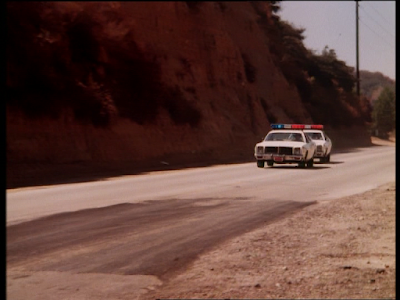
them being THE DUKES OF HAZZARD on TV. Bo and Luke Duke, just like Tom and Huck
before them, were the epitome of youthful daring and sunny adventures. They
lived in a fantasyland of dusty backroads and dense tree forests, of crystalline
creeks and sun-softened two-lane blacktops. They drove a muscled up 1969 Dodge
Charger with a characteristic charging horn and a Rebel Flag on its roof. And they
had a cousin, Daisy Duke, that was as hot as the Sun and as cool as the Georgia
rivers, and sexy as the sins country bumpkins went to confess in husky tones before
Sunday mass.
This time around I
landed in episode two of the second season, “Gold Fever” (1979). The plot, revolving around a gold swindle that
almost puts Boss Hogg on a three million dollar debt to some Texas crooks, and
Bo and Luke behind bars, is of no great concern to us here. What is, is a scene
where, as the country narration of Waylon Jennings tells us, in order to
impress the (to him, unbeknownst) swindler, Boss Hogg “shut the Boar’s Nest down, dressed Daisy up, and went all hog”. And
the Texan swindler is dully impressed. Who wouldn’t be, with Daisy (Catherine
Bach) dressed up in a frilly, v-necked mock-up of a French maid costume, all of
it short skirt, black pantyhose and deep cleavage. Daisy is a wet-dream come
true, and while the family-oriented comedy tone of the series makes us unmindful
that she’s only working for Boss Hogg because he had loaned money to Uncle
Jesse and the boys at a specially low-interest (to purchase the entry fee to run
with their car, the General Lee, on a competition), the exploitative role of
her attire makes any male viewer sizzle with desire.
Obviously, Daisy
Duke is a country bumpkin caricature. But Catherine Bach has made the
caricature come to sizzling live and throughout the entire run of the DUKES OF
HAZZARD (1979-1985) she was able to turn Daisy’s sometimes unbelievable naïveté
into one of her most charming assets, portraying her as negotiating a fine line
between knowing she’s super hot and not believing that fact at all.
Not that Daisy is
being naïve on the scene I’m considering here. When Boss Hogg keeps urging
Daisy to put more food on the plate of his guest, she is plainly aware that
when he answers with a subtly impolite “No, thank you, little darling, I’ve had
quite enough. (Pause) Food, that is” he is plainly staring at her generous décolletage.
As is Boss Hogg: “Careful, Daisy honey, the eyes of Texas are upon you.”
Daisy is there as
mere eye-candy, an object of desire that Hogg exhibits as a way of mellowing
his new business partner, impressing him; but also as a proud business man would
exhibit one of his expensive acquisitions. And one could even perceive in Boss
Hogg’s attitude a certain undisguised Georgian pride about the way this
Georgian beauty is firing up the Texan’s concupiscence. Hogg and the Texan
crook are on the same wavelength; Daisy however is not. She just rolls her eyes
at such infantile infatuation and nonchalantly proceeds to embarrass Hogg by
mentioning that a noise that came from the adjacent kitchen (Bo and Luke
inadvertently tumbling some trays) came probably from the usual rats that dwell
there.
This nonchalance on her part is what makes light – literally disarms – what could be perceived (and surely is, by today’s thought police) as the troubling objectification of a beautiful young woman in a family-oriented comedy/adventure series. For Daisy is at one with her hotness. It is part of her and who she is, and is something to enjoy and allow others to enjoy – on her own terms. The generosity of those terms made the happiness of countless kids in the late seventies and eighties, and will keep doing so while we’re able to travel back in time, to more simpler and happier days, through the oceans of time preciously stored in our jeweled plastic libraries.
Sunday, January 9, 2022
Ghosts of Summers Past
Back in the nineties, I enjoyed staying up well into the night, just writing. I used to tell myself that it was the sound of the world asleep that helped the ideas flow. But there is something more to it. The sense of going against the grain of society, just like a modern day vampire. It adds a frisson all its own. For at night, one becomes someone else entirely. Even if only inside one’s mind.
The light
of day brings clarity. It shines on one’s limitations, brings forth the smallest
imperfections; it draws you inwards, as the world presses down on your…hesitation.
Yes. One hesitates a lot more during the day hours. Things are less certain.
The clarity of form, breeds insecurity about intent. Can you reach what you
desire? If so, will it live up to your expectations?
Somehow you
withdraw when life proves willing. Again, you feel insecure. Unsure about
making the choice, taking the step, accepting the risk. Again, yes, you
hesitate. You fear to miss the right choice of words, to provoke the careful filigree
to dissolve in a hapless mess. You fear failure.
Oh, but at
night. The whole world changes. Working at night, especially in those hot
summer nights when the sweat runs over your skin on the wee hours of the night,
like a cool blanket of molten lava pouring from your erupting, feverish mind, the
ghosts of the day come alive. And all of life palpitates with promise.
Loosing yourself
on the stillness of the air, without the merest hint of a breeze to flutter the
curtains, you’re the sorcerer supreme of your all multiverse of desire. All
hesitation is gone. Action seems incapable of error. Imperfection is erased,
failure not a possibility. What you have denied is now yours to grasp. The
stuff of your dreams is now putty in your hands.
And once day comes again, its light is no longer frightening. Hesitancy is gone. Every trembling doubt is answered with crystal clarity in the afterglow of creativity. You have beaten the blank page. You poured your dreams into the world, bereft now of insecurity, naked for all to see. Unashamed. Confident.
Such is the intensity of realisation, that you erase yourself from the picture. Your dreams have taken form and, when morning comes, they’re all that remains. Like ghosts of hot summer nights.
Friday, December 31, 2021
What the Future Brings
So the wheel of
time keeps turning, and once more there comes the painful time when one must
look back into his past achievements and take measure of his worth. And,
looking back over my shoulder, blog-wise, there’s not much to be seen… nor to
be said. Just the vast empty space of posts unwritten, the silent digital
wasteland of unfulfilled ideas, of promises unkept. As one year dissolves into
another in the vertiginous movement of our rock around the sun, again there
seems to be a springtime of the mind. A whispered promise that everything will
be different this time. Will it? Or will it be just the same newfound impetus, bound
to die on the first confrontation with the empty sheet of virtual paper on
screen? Does it matter? To anyone but me? Will 2022 be just 2021 with a new
coat of paint? Let’s wait and see. Let us brave it, and find out. Welcome to
the new year.